
Start a Union City Residents Directory Search
A useful search begins with the fact already in hand. An address belongs first in the Union City Public Viewer and the Alameda Assessor search. A legal dispute, estate, or name in a filing belongs in Alameda Superior Court. A family-history question may begin with a directory, census, obituary, or the Washington Township Museum of Local History. A business connection takes a different route through the city license search, Alameda fictitious-business-name files, and California Secretary of State records.
Each source answers a narrow question. The assessor connects a site address to an APN, which is the county parcel number. The recorder indexes parties to recorded instruments, not residents by street. The voter tool confirms the searching voter's own status after identity checks. Printed directories can show an asserted address at a past date, while a deed shows a recorded transaction. Keep those meanings separate.
- Write down the name, spelling variants, approximate date, and known Union City place name.
- For a property question, use the address or APN to establish the parcel and its situs.
- For a court question, search the Alameda portal and save the case number, role, and filing date.
- For a historical question, repeat the search under Alvarado, Decoto, and Washington Township.
- Use a focused request to the record custodian when a documented record is not online.
Note: A name-only result is a lead; it does not prove a current Union City residence, identity, or household connection.
Where Union City Keeps Resident Records
Union City records are divided among city, county, state, and court custodians. City Hall keeps municipal meeting material, staff contacts, licenses, permits, and requestable city records. Alameda County handles deeds, parcel information, taxes, vital certificates, and election administration. The court is a separate branch with its own access rules. These offices form the working spine of a Union City residents directory, but none is a complete list of residents.
Alameda County Clerk-Recorder
1106 Madison Street
Oakland, CA 94607
1-888-280-7708
Alameda County Assessor
1221 Oak Street, Room 145
Oakland, CA 94612
510-272-3787
Alameda Registrar of Voters
1225 Fallon Street, Room G-1
Oakland, CA 94612
510-272-6973
Union City Clerk
34009 Alvarado-Niles Road
Union City, CA 94587
510-675-5448
Union City Property Search by APN
The Alameda County Assessor property application is the best starting point when the known fact is a street address. It offers three mutually exclusive modes. The public workflow is not a public owner-name directory. Select the address or parcel route, then use the result to understand the property record before seeking current ownership information from the Assessor or the recorded deed.
| Control | Type | What to enter |
|---|---|---|
| Search Criteria | Radio group | Parcel Number, Type Ahead Address, or Property Address |
| Parcel Number | Text | Use the dashed format shown on the tax bill, such as 123-345-67 |
| Type Ahead Address | Autocomplete | Select the standardized suggestion offered by the application |
| Property Address | Address inputs | Search the site address rather than a person name |
| Search / Reset | Buttons | Run the selected query or clear the form |
A parcel result may distinguish APN, situs, land and improvement values, use, tax-rate area, and map links. The physical situs is the location of the land. A tax mailing destination is where notices go and may belong to an owner, representative, or other address. It is a clue, not proof that a person lives at the parcel.
For a full address-by-address pass, continue with the Union City streets directory workflow, which keeps the parcel, deed, permit, and historical occupant layers separate.
The Alameda parcel viewer and city map add boundary context. The parcel number is the useful bridge from map to recorder. Keep it with the search date because parcels can split or combine, and a later APN may not be the same identifier used in an older deed.
Alameda County's official-records page explains the next step after a property search: use the current party name in the recorder index. The recorded instrument, not the map bubble, supplies the legal description and the title trail.
Note: The assessor's online modes are parcel- or address-led, so a citywide Union City name search should not be promised.
Union City Deed Trail at 1969
Alameda County real-property records reach back to the county's 1853 organization. The electronic party index covers 1969 to the present. Records from 1853 through 1968 remain a microfilm and in-person research task at the Clerk-Recorder's Oakland office. The break is about search format, not a claim that earlier deeds disappeared.
A recorder index is arranged around parties to a recorded document. It is not a street-address index. Start with the parcel, obtain the current title party and instrument reference, then search that person as a grantee for the acquisition. The grantor on that deed becomes the earlier party to test. Repeat while matching the exact legal description, subdivision map, lot, or metes-and-bounds language.
Copies cost money. The county lists plain copies at $3.50 per page and certified copies at $4.50 for the first page plus $3.50 for each additional page. Online ordering adds a $2 convenience fee and requires an instrument number. Mail requests require payment and a self-addressed stamped envelope. Recent recordings may take time to appear, and the Customer Service Unit can help confirm a recent instrument when given document type and party names.
Alameda's county-seat history adds a local twist. Alvarado was the original county seat when Alameda County formed, before Oakland became the county seat in the 1870s. That is why a historic Union City-area trail can pass through older Alvarado records rather than a modern city archive.
The Alameda official public-records capture shows the county's deed-index access point. It belongs beside the 1969 explanation because a modern web entry does not remove the need for older microfilm research.
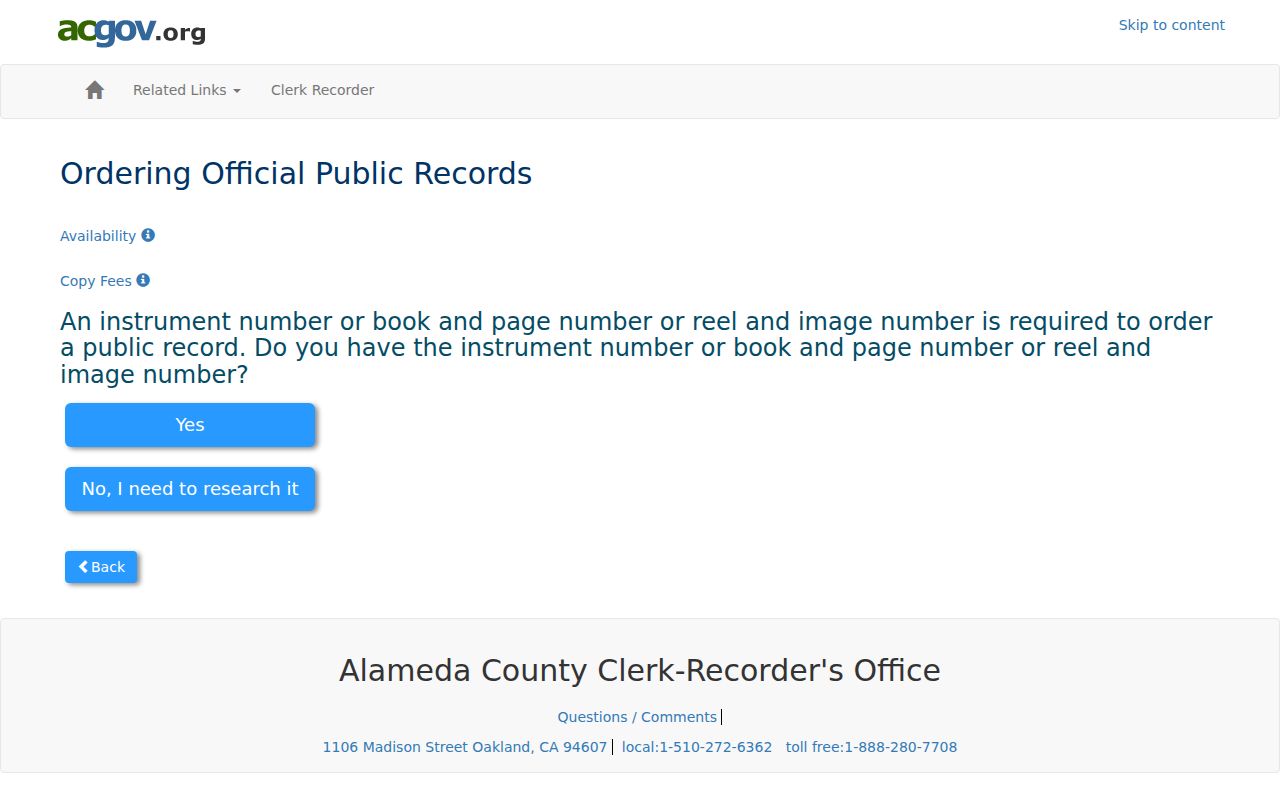
The image illustrates the reference trail, while the Public Records Room remains the fallback for earlier years and for document copies that require a known identifier.
Current Union City Resident Directory Sources
Current-looking sources do not all describe the same kind of person. A city staff directory lists public roles. A business license describes a licensed premises. A deed identifies recorded parties. A voter status tool is identity-gated for the voter concerned. The following coverage map keeps the distinctions visible.
| Source | What It Lists | Keeper | Access |
|---|---|---|---|
| Assessor and parcel tools | Parcel and assessment facts | Alameda County Assessor | Free address/APN search |
| Official-record index | Parties to deeds, liens, and maps | Alameda Clerk-Recorder | 1969-present online; older microfilm |
| My Voter Status | One voter's status, precinct, and ballot information | California Secretary of State | Identity-gated self-lookup |
| City staff directory | Names, titles, emails, and public phone numbers | Union City | Free online directory |
| Business license search | Licensed business and premises clues | Union City | Free public search |
A current resident directory cannot be built by adding these rows together. Each row has a different date, purpose, and definition of a person. The county's tax and property services can point to a parcel, but the record may not show every household member. The city business search can tie a trade name to a premises, but it does not prove that a registrant lives there.
Use a second independent record before naming a match. A deed party plus APN is stronger for ownership. A directory entry plus a school year and obituary can support historical identity. A license number or case number is safer than a common name alone.
Union City's staff directory is a useful official people directory for public roles.
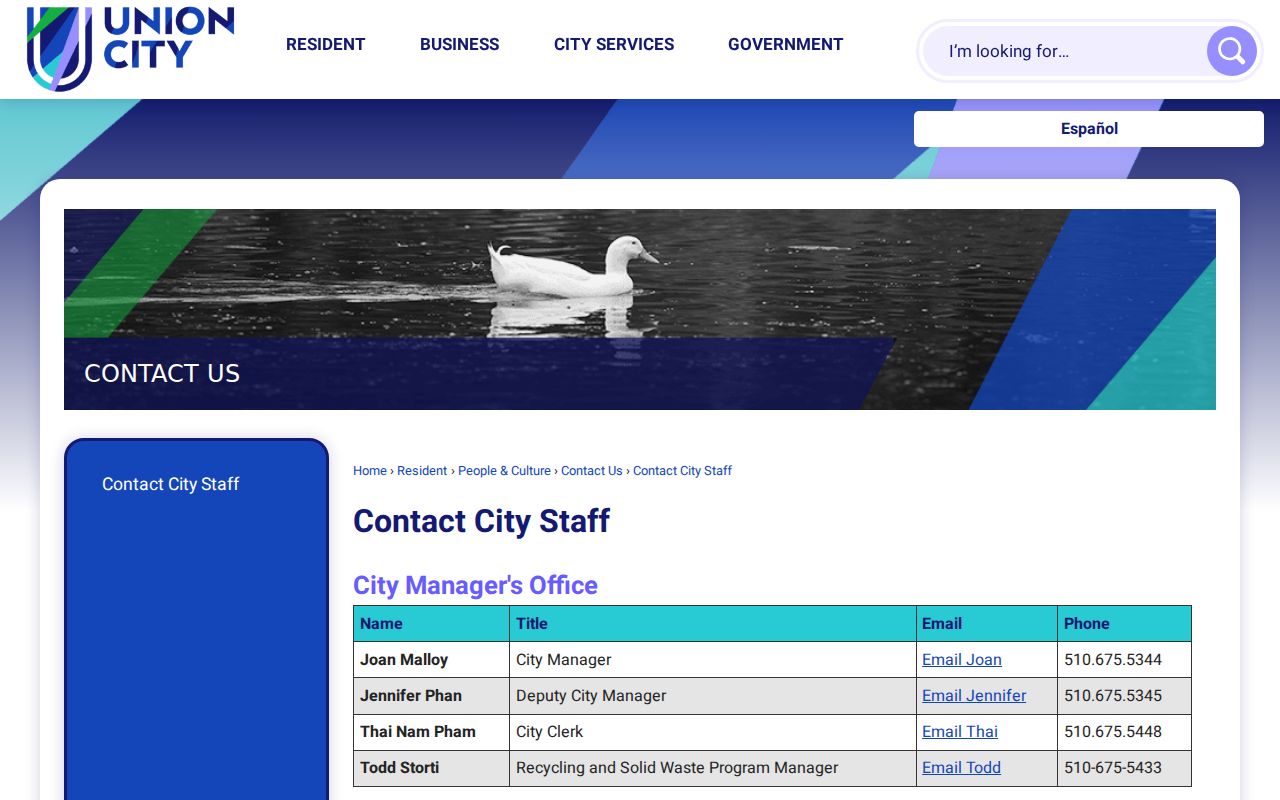
Its entries route a records question to the right department, but they should not be read as a private-residence list.
California Voter Status Is a Self-Lookup
California's My Voter Status tool is useful when the question concerns the searching voter. It asks for First Name, Last Name, Date of Birth, and one identity-matching credential, such as a California driver license or identification number or the last four digits of a Social Security number. It returns registration and election information after an identity check. It does not offer a public browse of Union City names or streets.
A successful response can show registration status, party preference, county, residence or mailing address on file, precinct, polling or vote-center information, vote-by-mail status, and whether participation was recorded. It does not reveal ballot choices. A failed match can reflect spelling, a recent move, a pending update, or a credential mismatch. It is not proof that a person is unregistered.
Broader voter-file access is purpose-qualified under Elections Code sections 2194 and 2157.2. Approved election, scholarly, journalistic, political, or governmental users must apply, describe intended use, identify recipients, and certify security. Driver license numbers, Social Security numbers, and signatures remain protected. Safe at Home participants receive additional address protection.
The California voter-status capture shows why this tool belongs in a personal verification workflow rather than a residents directory export.
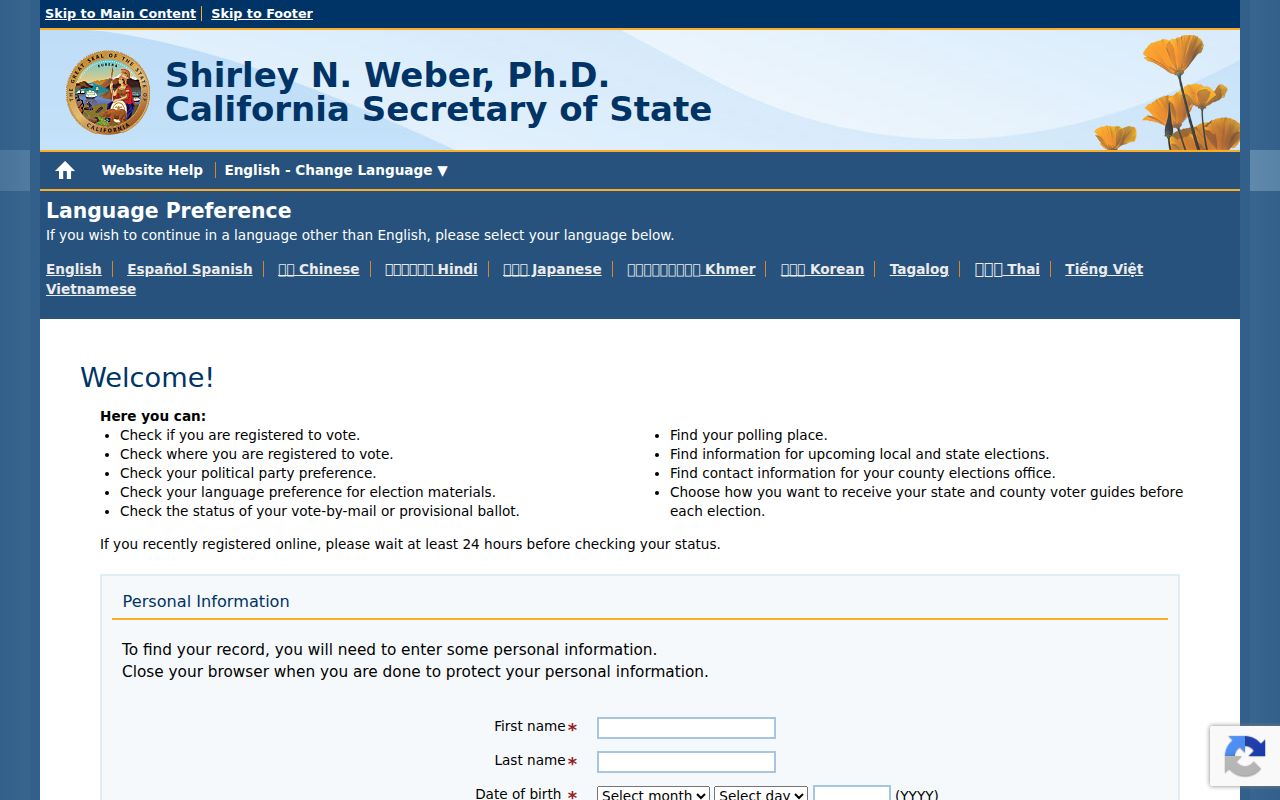
For a lawful personal lookup, save the response date and contact the Alameda Registrar of Voters when the result looks stale or incomplete.
Alameda Court Records Need a Case Number
Union City has no separate municipal court. State matters route to Alameda Superior Court, while federal matters may appear in the Northern District of California. Alameda's eCourt portal covers civil, family, probate, mental-health, and adoption case information through an account-gated system. Its documented case-number workflow uses a case-number field, a robot check, and a search control. Party fields and date filters can change, so a name-only assumption is risky.
A result can show case name, case number, case type, type of action, parties, register events, department information, document name, filing date, filer, and a half-page preview. Full images may cost money. Detailed criminal, family, juvenile, guardianship, mental-health, and several protective-order records have tighter remote-access limits under California Rule of Court 2.503. A courthouse terminal or clerk procedure may show what the public web view does not. Confidential and sealed material remains closed.
Federal PACER is a separate route for a Northern District case. Its docket fields include the caption, parties, attorneys, document entry number, date, title, and filer. In 2026, most PACER documents cost $0.10 per page, capped at $3 for a single document or case-specific report, with quarterly charges of $30 or less waived. Older federal files may require archive retrieval.
The Alameda eCourt capture shows the account gate and search context. Use it to locate a case number, then verify the party role and dates before treating a namesake as the Union City person sought.
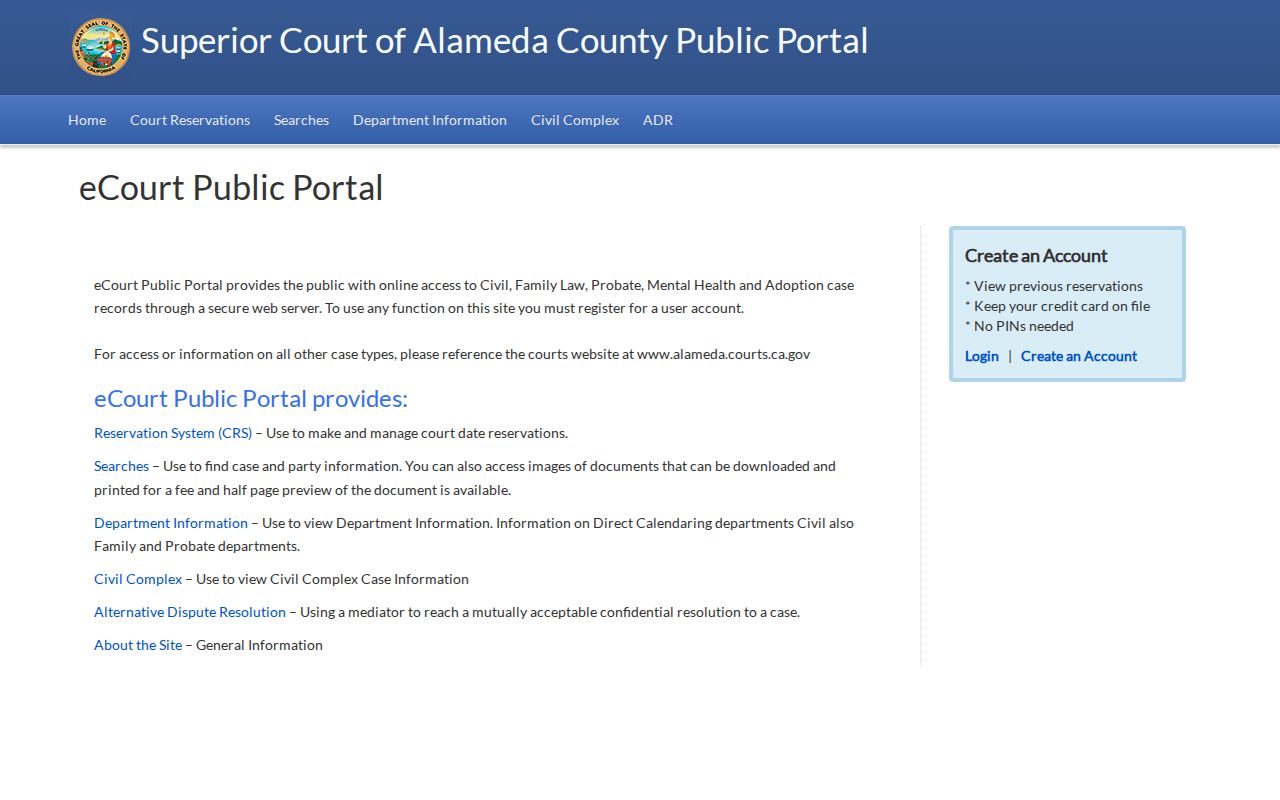
For category-specific access, the Alameda court services page is the safer starting point than assuming one portal handles every case type.
Union City Vital Records Have Copy Rules
Alameda County and the California Department of Public Health divide vital-record work. The county is usually the practical first custodian for a Union City birth, death, or marriage event. CDPH offers statewide forms and a state alternative. Divorce files belong to the court, while CDPH can issue a certificate of record for qualifying dissolutions. A vital record is evidence of an event, not an open list of everyone who lives in a city.
California distinguishes an informational certified copy from an authorized copy that can establish identity. Under Health and Safety Code sections 103525 and 103526, informational copies of most nonconfidential birth, death, and public-marriage records are generally available to requesters, but an authorized copy requires a qualifying relationship or category and, for mailed applications, a notarized sworn statement. Confidential marriage copies are limited to a party or court order. Adoption records and altered original birth records have separate confidentiality rules.
| Record | 2026 CDPH fee | Key access point |
|---|---|---|
| Birth | $31 | Authorized category or informational copy |
| Death | $26 | Authorized category or informational copy |
| Public marriage | $19 | Application rules and copy type apply |
| Divorce record certificate | $18 | CDPH certificate, separate from the court file |
State forms commonly ask for the applicant, event date and place, names, relationship, copy type, purpose, signature, and number of copies. Fees can be retained when no record is found. Do not confuse a historical index, an informational copy, and a certified identity document.
Note: A divorce clue may point to a case index, a full decree, or a CDPH certificate, and each product has a different custodian.
Union City Heirs and Estate Records
Finding an heir is a records-chain question, not a single-name lookup. Start with an Alameda Superior Court probate case when one is known. A public petition or docket may identify a decedent, representative, interested party, or counsel. Pair that lead with a death record or obituary, then examine recorded transfers and the legal description of any property. The goal is to connect roles and dates, not publish a guessed address.
Probate attachments and confidential material may be unavailable remotely. A court index can establish that a case exists, but it does not by itself prove the truth of every allegation or relationship. An obituary can supply family structure, although it is still a secondary notice. A deed can show a later transfer, but a recorded party is not automatically an occupant.
The Washington Township Museum adds a particularly local genealogy route. Its Union City papers include early-family studies, African-American history for the area, biographies, “Homes of Vallejo Street,” and a Pioneer Genealogical Database containing 340 early Alvarado and Decoto residents. Treat the compiled tree as a lead, then verify it with deeds, probate, census, vital, church, or newspaper evidence.
Alvarado, Decoto, and Washington Township are essential search terms for older estate records. Union City incorporated in 1959, so a pre-incorporation probate or obituary will not necessarily use the modern city name.
When Union City Records Are Not Online
“Not online” often means the record has a different access channel. Union City uses NextRequest for identifiable city records such as permits, correspondence, rosters, historic license lists, code records, and contracts when no purpose-built search exists. A useful request names the department, record type, street or person, and a bounded date range. Under Government Code section 7922.535, the agency generally determines within ten calendar days whether records are disclosable, with a possible written extension of up to 14 days for unusual circumstances.
The county's CPRA form is a fallback for county-held records, but it is not a substitute for a court request or a recorder-certified-copy order. Court files follow court procedures. Older deeds require the Public Records Room and microfilm. The library, museum, Oakland History Center, California State Archives, and National Archives provide historical alternatives when a current portal is the wrong tool.
The Union City records-request capture shows the city's online fallback for an identifiable record.
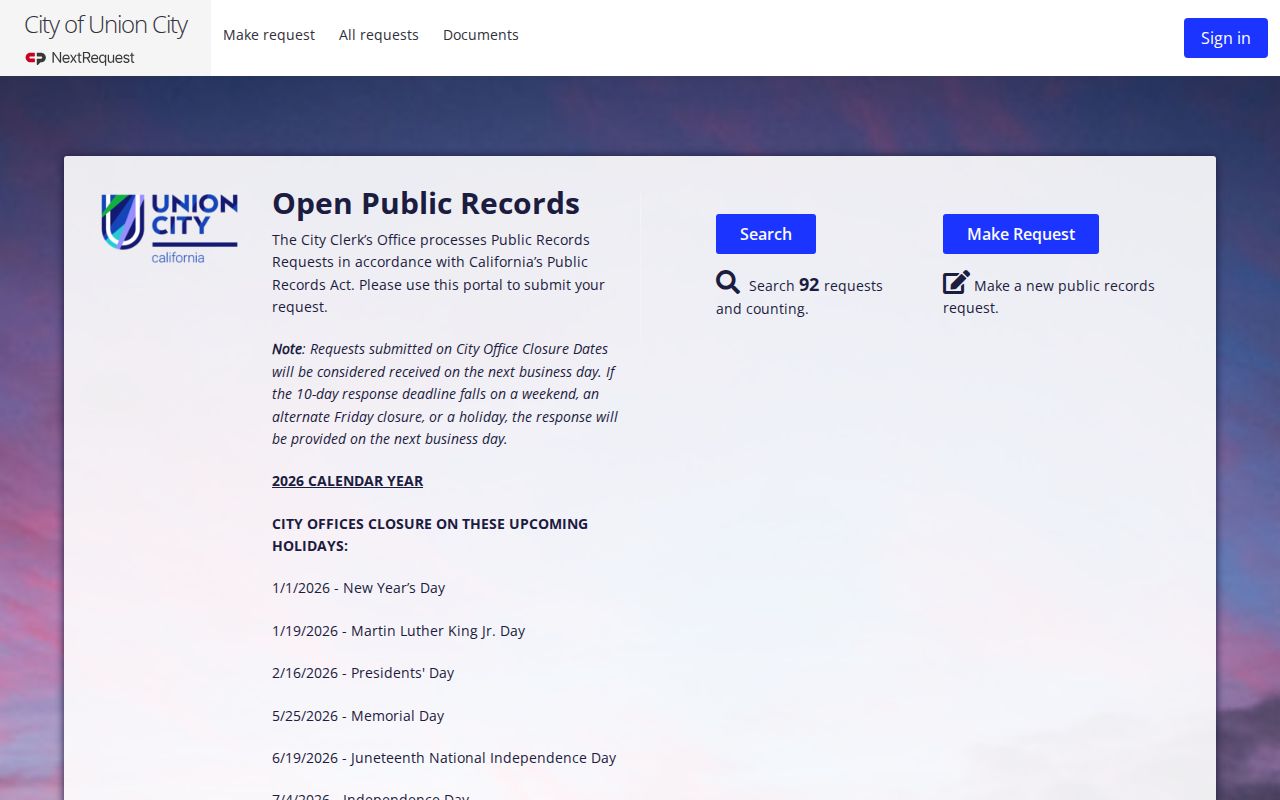
Submit a narrow request, keep the acknowledgment, and ask the custodian to clarify the record series rather than asking the city to create a new residents directory.
The California response-rule capture is useful when a request needs a clear determination timeline.
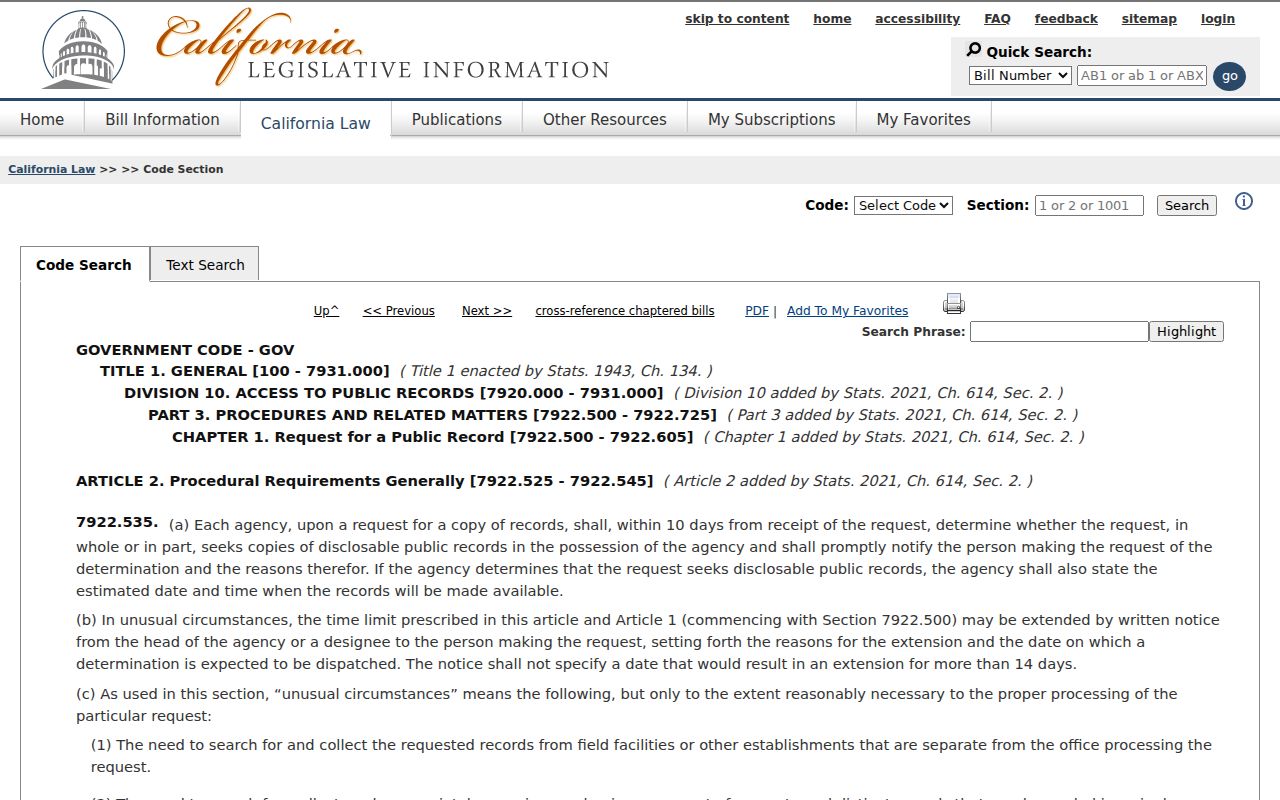
The ten-day determination is not a promise that every record will be produced in ten days. Exemptions, redactions, duplication costs, and the identity of the actual custodian still matter.
Protected Addresses in California
Some people will not appear in a normal Union City search, and that absence can be intentional. Safe at Home supplies a substitute mailing address and confidential mail forwarding for eligible survivors and certain protected participants. California voter addresses can receive added protection under Elections Code sections 2166, 2166.5, and 2166.7. DMV information is restricted under the federal Driver's Privacy Protection Act. Adoption, juvenile, sealed, and confidential court records have separate barriers.
Public records can also contain fields that should be redacted or corrected. A recorded document may remain public while a sensitive identifier is removed. A voter file may be available for a permitted statutory purpose while signatures and identity credentials remain closed. A commercial removal request cannot correct an official deed, court, assessment, or license record. Corrections belong with the custodian that created the record.
Lawful personal research. Union City records may help with family history, civic questions, property curiosity, or reconnecting. Do not use a lookup to stalk, harass, intimidate, or harm anyone, and do not republish protected information.
Alvarado, Decoto, and Union City Records
Union City has a built-in name-geography problem. The city formed from Alvarado and Decoto in 1959, with eastern hills annexed in 1962. A directory, census schedule, newspaper, deed, church record, or school item from before incorporation may be cataloged under one of those communities, Washington Township, Hayward, or Alameda County. Searching only “Union City” can hide the very household being sought.
The regional volumes and local-history shelves are described in the Union City city directory collections route, while this section keeps the older place names tied to the broader residents-directory workflow.
The Washington Township Museum's research library holds local books, yearbooks, newspapers, photographs, ledgers, maps, blueprints, clips, audio, original documents, and a selection of Alameda County assessor books from 1893 to 1902. The Union City Library advertises a local history file, but its public page does not list a full directory or obituary finding aid. The Oakland History Center supplies a wider regional shelf, including Alameda County voter registers from 1867 to 1944 and censuses from 1870 to 1960 onsite.
Modern records are not free from this problem. A city boundary, postal place name, school area, and land parcel can describe different geographies. Use the current map for the boundary, the APN and legal description for land, and the historical place name for the collection search.
Alameda court services show the regional custody pattern.
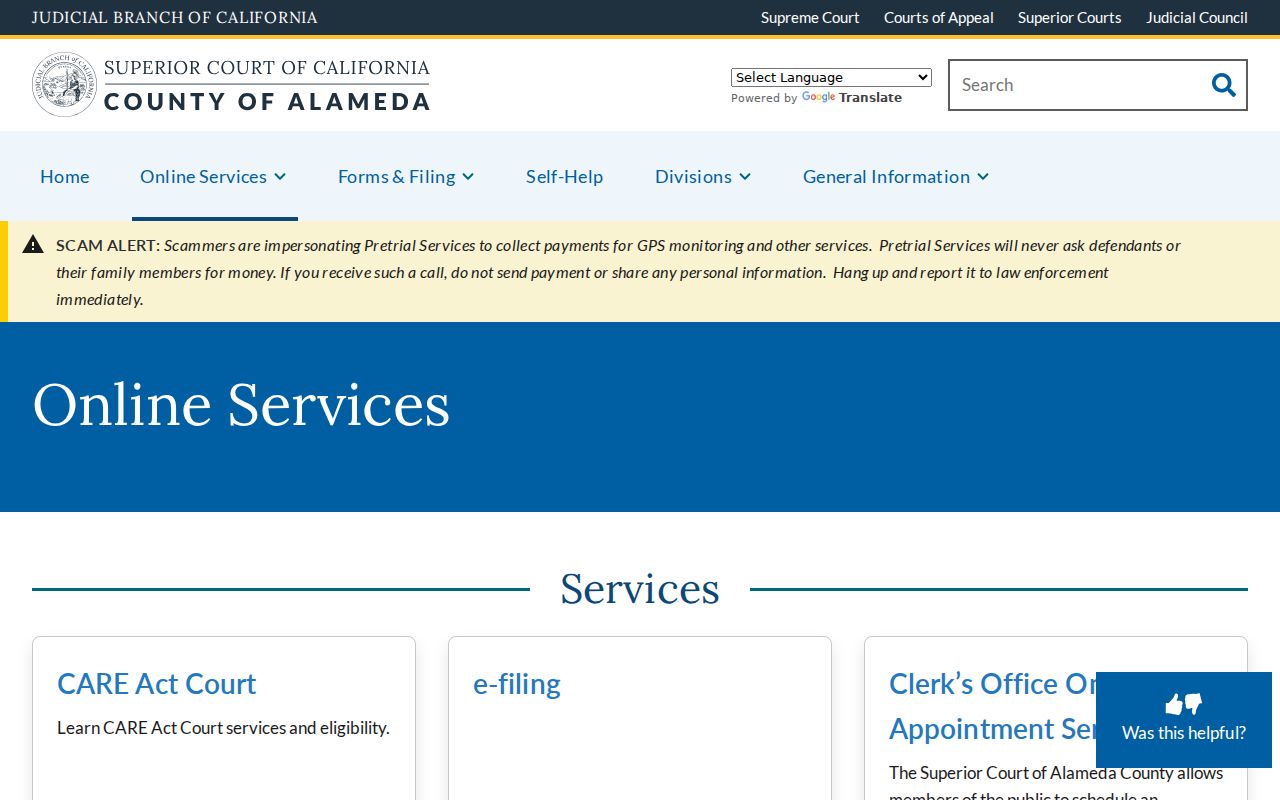
The court route follows Alameda County even when a historical source uses Alvarado or Decoto.
Verify a Union City Resident
A reliable Union City residents directory result is usually a chain of identifiers. A common name becomes more useful when paired with a middle initial, an address and year, a parcel number, a court case, a license number, or an entity number. Keep the roles distinct: situs is the physical parcel, mailing address is a notice destination, an agent address serves a business, and a directory entry records what a publisher reported at a given time.
- Roll
- A list maintained for a specific purpose, such as assessment or voter administration, not a universal resident list.
- Index
- A finding aid that points to a record. It may show names and dates without displaying the underlying image.
- Criss-cross directory
- An address- or telephone-arranged directory that can connect a place with a listed occupant or business for a publication year.
- Parcel
- A mapped unit of land with an APN; the parcel is not the same thing as every household inside it.
The strongest match uses two independent records and a time check. For a property question, map the address, record the APN, inspect the current title path, and compare a second source. For a family-history question, pair a directory with a census, obituary, vital index, or museum file. For a legal event, compare the party role, case number, and disposition. Keep the inspection date because portals and records change.
Note: A record can be authentic and still answer a different question from the one a researcher first asked.
Official Records Versus Compiled Listings
Official sources and compiled listings serve different purposes. Official county and city records have a named custodian, an access rule, and a defined record series. A compiled directory may combine public fields, stale entries, and inferred associations. Neither should be treated as a universal residents directory. The safest practice is to use a compiled entry only to generate a lead, then verify it against the office or collection that created the underlying record.
| Question | Primary source | What to verify |
|---|---|---|
| Where is the parcel? | Union City map and Alameda Assessor | Address, APN, situs, boundary, map date |
| Who signed a recorded instrument? | Alameda Clerk-Recorder | Party role, recording date, instrument, legal description |
| Was a person registered? | My Voter Status or permitted voter-file route | Identity match, status date, statutory purpose |
| Who appeared in an older household? | Directory, census, obituary, or museum collection | Publication year, place name, source notes, corroboration |
That comparison is the practical heart of a Union City residents directory. It protects family-history research from overclaiming, helps a property researcher avoid confusing title with occupancy, and makes a public-record request specific enough for the right custodian to answer.
Union City Records Change With Time
Recent access changes matter. Union City is moving official web and email domains toward UnionCityCA.gov. California's DROP platform began statewide data-broker deletion work in 2026, but it does not erase lawful deeds, court records, assessment rolls, or other government records. Oakland History Center access is again available after remodeling, restoring a key regional shelf for Alameda County census, voter-register, directory, and obituary research.
These changes reinforce a simple rule: save the custodian, URL, record date, and search date together. If a portal moves, use the official city or county domain to find its replacement. If a search result disappears, ask whether the record moved behind a login, into a reading room, or into a request process. A durable Union City residents directory workflow is built from citations and identifiers, not from a single page.